


Nebraska’s Growing Role in Health Initiatives Highlighted During Visit by HHS Secretary Kennedy
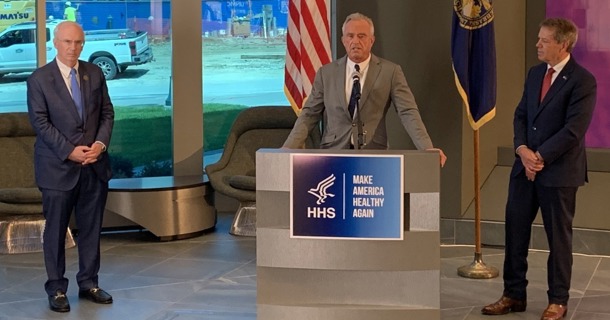
Omaha, NE – Nebraska Governor Jim Pillen, U.S. Health and Human Services (HHS) Secretary Robert F. Kennedy, and University of Nebraska President Dr. Jeff Gold highlighted Nebraska's growing role as a national leader in health security, rural health transformation, nutrition, and efforts to improve the health of Nebraskans.
Sec. Kennedy met the Governor and Dr. Gold at the University of Nebraska Medical Center's Global Center for Health Security on Thursday where they toured the facility and met with Nebraska leaders and medical professionals who recently supported the successful quarantine of Americans who had been exposed to hantavirus on the cruise ship MV Hondius.
The visit highlighted the collaboration between state government, the University of Nebraska Medical Center (UNMC), Nebraska Medicine, and HHS to strengthen America's ability to respond to infectious diseases and other biological threats.
Sec. Kennedy praised Nebraska's preparedness capabilities noting that the state plays an important role in America's national security.
"This is a legendary facility, and most of you don't probably appreciate how far-reaching the influence of this facility is around the world and I could not be more impressed or more inspired,” said Sec. Kennedy. "This facility is absolutely critical to our national security and one of the reasons I wanted to come out here today was just to see this legendary place, this kind of mecca for biocontainment firsthand."
Dr. Gold said that the University is proud to advance the country’s national health security efforts.
“Our professionals at UNMC and Nebraska Medicine continually train to stand ready to assist, when we are called. The hantavirus response is just one example of how we pioneer breakthrough research, train the next generation of health care leaders and deliver resilient care to protect and serve our country.”
"Nebraska's greatest strength is its people, and the expertise and commitment demonstrated at UNMC and Nebraska Medicine represent some of the best health security capabilities in the world," added Gov. Pillen. "Nebraska has consistently demonstrated that we don't settle for being second. We were prepared to answer the call, providing compassionate care and support while protecting the health and safety of our communities.”
Gov. Pillen and Sec. Kennedy also discussed Nebraska's role in advancing the Make America Healthy Again (MAHA) agenda, including efforts to improve nutrition, strengthen families, reduce chronic disease and promote greater health and independence.
Nebraska was the first state to implement a SNAP waiver restricting the purchase of soda and energy drinks with SNAP benefits. The SNAP waiver represents a broader effort to address the nation's growing challenges with chronic disease and poor nutrition by encouraging healthier choices among SNAP participants while maintaining access to a wide range of nutritious foods. Nebraska's approach is part of the state's broader commitment to the MAHA agenda and to finding practical, state-led solutions that can improve health outcomes over the long term.
The leaders also highlighted Nebraska's implementation of Medicaid work requirements. Nebraska led the nation in implementation, which is designed to connect eligible Medicaid recipients with employment, education, job training and other activities that can help individuals move toward greater economic independence.
"Governor Pillen has led the country on the MAHA agenda," said Sec. Kennedy. "He was the first to pass the SNAP waiver. He was one of the first to put bell-to-bell legislation to control cell phones in schools, which is absolutely critical to our children's mental health.”
Sec. Kenney also applauded Nebraska for the quality of the state’s Rural Health Transformation Plan. The state received $218 million in its first-year award, one of the highest in the nation. One of the key focus areas is nutrition and expanding access to healthy foods. The Secretary noted that in the battle against chronic disease, understanding the role of nutrition is critical, including among medical professionals.
“Doctors should not understand just how to treat disease. They should understand how to prevent it and what caused it,” said Sec. Kennedy. “We now spend almost $4.3 trillion a year on chronic disease, and most of that is food induced.”
He continued, “For decades, we trained doctors to treat the consequences of poor nutrition while giving many of them remarkably little training in nutrition itself. Almost 80 institutions of higher education across 36 states have committed to strengthening nutrition education, reaching over 52,000 medical students this autumn. And Nebraska helped lead that effort from the beginning. The University of Nebraska was among the first institutions to commit.”
“The best thing about Nebraska is the people. People can only operate at their full potential if they are healthy,” said Gov. Pillen. “Nebraska is proud to be a national leader in improving the health and well-being of our residents, but the work does not stop at our state’s borders. Nebraska looks forward to continuing its strong partnership with our federal partners to advance President Trump’s vision to Make America Healthy Again and ensure the health and well-being of Nebraskans for generations to come.”